Saturday, January 5, 2019

Found in a Book

Two Doors Down by Annie McCartney
Bill came home with this book one day, having found it in the wee free library when he went to leave a few books in there. he said he thought I might like it. When I saw the title, it seemed familiar. My first thought was that I must be thinking of the band that Bill likes of the same name. Then I read the back and it dawned on me that I’d seen this listed on a BBC radio schedule once or twice. I may or may not have listened to an episode--I have a vague feeling that I might’ve, but not sure. In any case, I quite enjoyed the book. It did address some class issues, albeit in a sort of predictable way, but mostly it was just a lighthearted, fluffy read. Sally is a cleaner who works for several families on Marlborough Road in a section of Belfast. To her, they seem quite well off, although she later finds out they’re not as well off as some. She is quite a competent person who really keeps the dysfunctional families afloat--she smooths out ripples, keeps things in order, and the kids all love her. She keeps parts of her life hidden from them nonetheless, and when this causes some misunderstandings on all sides, she decides to take a different job in spite of her misgivings. Things do not go well for her or the families on Marlborough Road. Can they all resolve the issues they are facing and live happily ever after? You can probably guess the answer without me telling you!

Inside the book was this photo.
I'll donate the book to a charity shop, but I'm keeping the photo--not quite sure why, but I find it interesting.

The next book was less fluffy, even though the idea for it originated in a pub, according to the introduction:
Scribner Book of Irish Writing edited by John Somer and John J. Daly
I found this book in a charity shop a few years ago. It’s a nice collection of short stories by Irish authors. The editors wanted to have a sample of stories that illustrated the changing approaches to writing through the 20th century, beginning with Elizabeth Bowen. They included more well-known authors as well as those who are not household names--or at least weren't when the book was published. I must admit that the last story, by Neil Jordan, called 'The Dream of a Beast' was not one I enjoyed and it seemed to go on and on. When I finished it, I closed the book and said, 'What the hell was THAT all about?' I googled and discovered that I am not alone in my dislike of the story and puzzlement about just what was supposed to be going on. There were all kinds of explanations, and  while a few people loved the story, most thought it went on way too long and didn't have a whole lot to  say. I am in the latter camp and wouldn't read anything else by this guy, who is most well known for screenplays and movie stuff, I think. So the book ended on a bad note, but that was the worst story in the collection and since it's been thoughtfully placed at the end, one could just read the book and call it finished when one finished the story before it. I wished I'd done that!

I hope you're enjoying whatever you're currently reading!

Friday, January 4, 2019

Chocolate Chunk Raspberry Muffins

Yesterday, I made a batch of chocolate chunk raspberry muffins--yet another variation on the muffin recipe I have made in many different and delicious ways.
I made these the same way I made the orange cranberry version I posted about here with the following small changes:
Use milk instead of orange juice to soak the oats and add a teaspoon of vanilla (or almond) extract.

Use frozen raspberries instead of cranberries and chocolate chunks/chips (I used 100g, but add as many as you want) instead of nuts. Or use some nuts and some chocolate chips, if you prefer.

I don't think I've ever made these before, but I'll be making them again--they are yummy!

I was feeling a bit nostalgic when I looked at the post about the cranberry orange muffins, reading the bit about having snow and seeing my recently packed away snowman mug. We haven't seen any snow, but I did enjoy using my snowman mug during the festive season, sipping my tea while reading a couple of cosy Christmas mysteries that were in the mix for December.

Trouble in the Cotswolds by Rebecca Tope
I came across this book in a charity shop a few months ago and bought it, having read a few of the author’s other books, including one I found at the same charity shop that involved a Halloween storyline. This one takes place at Christmastime so I saved it for December and I’ll donate it back to the charity shop now I’ve read it. As it turned out, the days were even the same as this year, with Christmas Eve falling on a Monday, Christmas on a Tuesday. These are books that are enjoyable enough for me to pick one up when I come across it, but not something I would actively seek out. In this book, Thea, the housesitter and amateur detective, agrees to take care of a house over the holiday. things do not go smoothly, however, as Thea gets the flu, one neighbour is found dead, and another is a bit sinister. Happy holidays indeed!

The Santa Klaus Murder by Mavis Doriel Hay
I discovered a different book by this author in a local charity shop. I’d never heard of her, so looked her up. I found out that she was a Golden Age writer, but only wrote 3 mystery novels. Her passion was apparently rural handicrafts and she did a lot of research in that area and wrote several books. When I saw that one of her three mysteries was a Christmas cosy, I asked Bill to see if he could find a copy, which he did. The setting is pretty typical for such a book--big house, snow, family members and others who have uneasy relationships with one another thrown together for the holiday. The patriarch doesn’t make it through Christmas Day and based on the bits of angora fibre on his suit, it looks like Santa did it, shedding some of his fur trim in the process. I’ve packed this one away with the Christmas things and maybe I’ll revisit it in future. 

It's pizza night tonight and my crust dough is in the bread machine. I'll have some soup cooking overnight in the slow cooker and tomorrow I'll make some jalapeno cheese bread to go with it. I like having the soup done when I come downstairs in the morning because that gives me a couple of days of heat and eat suppers, which in turn means more time to read or to stitch. I can chop veg and get everything in the slow cooker while I wait for the pizza to bake and then just turn it on later. There's no meat in it, so don't have to worry about keeping it cold.

Happy Friday!

Thursday, January 3, 2019

Blooms and Books

We've gone directly from autumn to spring it seems, and the flowers continue to bloom. The planters are already colourful and there are plenty more colours on the way.
keeping water handy :-)


One of the books I read last month was all about flower gardening:
A Life in the Garden by Penelope Lively
In this book, the author, a keen gardener herself, describes her own gardens and what they’ve meant to her. She reflects on how her gardening life has changed as she moved to different places and has aged. She also discusses gardens in literature, how the authors wrote about them, and how they approached their own gardens. I am not a flower gardener and no doubt someone who knows flowers and/or gardens themselves would have gotten a lot more out of it than I did, but even so, I enjoyed this book a lot. I am always interested in where people’s passions come from and how they are experienced. Bill and I have done a few different life story projects with artists and quilters in which this formed part of my interview questions. I see gardening in the same way I see other creative pursuits and I am always intrigued by what grabs poeple and why, so from that angle, this book was a fun read.

The natural world also played a large part in this poetry collection that I read a year or two ago and wanted to revisit.
Silent in Finisterre by Jane Griffiths

No gardens played any more than a peripheral role in the Agatha Christie books I decided to take another look at:
Ordeal by Innocence by Agatha Christie
I read an article that I am pretty sure I found in a Lit Hub email about Agatha Christie--why she is so much more popular than other Golden Age authors, how her work stands the test of time, what her strengths are and where her weaknesses come to the fore. I have loved Christie since I was a teen and have memories of stocking up on her books before we’d go off on vacation, whch usually entailed a long car ride. Sometimes I was disappointed when I’d buy a book, thinking I hadn’t read it, only to discover that it was one I’d read with a different title. Back then, the books were either 79 or 99 cents--I’m not sure what accounted for the price difference. Now I have them all on my e-reader, so can carry them around without the bulk and weight. Anyway, in the article, the writer commented that many people think they know the stories as she wrote them, but what they actually remember are the TV versions. I know this is often true for me. I haven’t seen more recent dramatizations, but was quite taken with David Suchet’s portrayal of Poirot and Joan Hickson’s Miss Marple (she is Miss Marple--no one else comes close). There was a series of Miss Marples in the early 2000s, I guess, first with Geraldine McEwan and then with Julia McKenzie. In these, they changed storylines and endings, added Miss Marple to stories she did not appear in, and even combined her with Tuppence Beresford in one. These were quite different from the books, so I could see the guy’s point when I read that part of the article. In writing about the various plot twists in some of her better work, he mentioned this book. I vaguely recalled that it was one I saw in which Miss Marple had been dropped into the TV version even though she wasn’t in the book, but didn’t quite remember the book itself without the overlay of the TV version, so I decided to read it. The bare bones of the story are that on a dark and stormy night, someone appears at a big house and speaks to the family patriarch about his son, who had been convicted of the murder of his own mother and had died in prison. He had an alibi, but the person who could vouch for him never came forward, so he was convicted, became ill in prison, and died there. Enter the visitor, who has some news for the family. This news is not really welcome and he doesn’t get the response he expects. This is not a Poirot or a Marple.

Third Girl by Agatha Christie
This was another Christie mentioned in the article I read. Poirot is in this one and is called into service when a young woman comes to him, says she thinks she killed someone, then disappears.

The Hollow by Agatha Christie
It was apparently an Agatha Christie month. I think this book was also mentioned in the Lit Hub article I read and then it was also listed in someone’s blog post abot the books she’d read, so I figured I’d read it, too. This one is a Poirot. I like him, but I like Miss Marple better and through the years I have always wished there were more books with her in them and fewer with him. Oh well--apparently Christie herself loathed Poirot after a while, but her publishers wanted more of him, so she obliged.

I can't honestly say I am happy about this never-ending spring thing, but the flowers are pretty, so I'll just focus on those. I hope it's a lovely day in your part of the world!

Wednesday, January 2, 2019

Climate Justice: Hope, Resilience and the Fight for a Sustainable Future by Mary Robinson

Since we're at the beginning of a new year and can have hope for what it will bring, I decided to begin my recap of the books I read in December with this one.
I found it in the e-book section of the library website.

First off, I think she made a good choice when she decided to present personal stories to illustrate what people are already facing (and have been for years) with regard to climate change and how they are responding in positive ways. It is an effective way to show what is going on--the personal is political, but often hearing the personal stories of individuals and seeing how they're affected makes the political aspects of an issue easier for some people to swallow. She includes a wide range of people in this book from all over the world and who have different ways of life, including a guy who has always worked in the fossil fuel industry and is now actively working to support change and fellow workers at the same time.

A review in The Guardian said this:
'The global initiative took Robinson to myriad countries, where she spoke to women who share two commonalities: they predominately work in the agriculture industry and their lives have been crippled by global warming. Their message remained the same: those least responsible for climate change are suffering from its most detrimental effects – namely, droughts, flash floods, rising sea levels and changing weather patterns, which in turn lead to unpredictable harvest seasons. Robinson thus concluded that climate change, human rights, justice, equality and individual empowerment are all inextricably linked. This is the central argument that holds this concise yet insightful and optimistic tome together.'

and this
'Robinson’s lucid, direct style works because it gives a voice to those who have taken it upon themselves to tackle Earth’s most pressing problems. The book’s central message is a mantra worth repeating: individual local action can grow into a global idea, producing positive change. Put simply: it’s up to us to take immediate action if we want to prevent our planet cooking itself to death in the coming decades.'

I should point out that she does not only talk to women involved in agriculture, as mentioned in the paragraph above. She speaks to women in the US south and far north who have had their lives impacted by climate change. She speaks to the Australian founder of 1 Million Women. The fossil fuel guy I mentioned above is Canadian. By presenting the stories of this diverse group of people along with the scientific findings and predictions about what climate change will do in an accessible manner, she makes the point that we're all going to be affected by this. Right now, some people are already paying a price for the lifestyles those of us in wealthy nations enjoy, but eventually, it will catch up with us, too.

As I was reading about how wealthier nations resist large changes because they say it will hurt the economy, an argument that has always seemed nonsensical to me, I was remembering that old commercial for Midas Brake Shops, I think it was--you can pay me now, or pay me later. Some people are already paying and some will pay later if we don't wake up. But we could choose to make changes. These changes might mean living a bit differently, but won't we have to do that anyway--and if we do nothing now, those changes will be forced upon us. If we started now, we might have more leeway to direct those changes a bit.

I like her optimism in this book--she truly does have hope. I think she is more optimistic than I am about how people will respond, but I have learned how to balance hope and what I know about how human cultures work, so even as my head tells me that we've left it for too long and the changes required will be too great and have to happen too quickly for them to embraced by change-resistant people, in my heart I hold out hope that we still have time to alter the trajectory we're on. Weird stuff happens, so we still have a chance. I make choices in my own life with that hope at the forefront.

I highly recommend this book.

Tuesday, January 1, 2019

The Blue Trees Are On, Mom!: Winter Stitching

When our daughter was very small, we lived in an apartment located at the end of a cul-de-sac of apartment buildings. Each building looked the same, with a step or two leading to a small covered porch and the front door. There was a railing around the porch roof to make it look like a balcony, I guess, even though there was no access to it from inside the building. At Christmastime, they'd put trees up there and they all had blue lights on them. She loved those trees and would sit looking out of her bedroom window as it was getting dark and eventually I'd hear her call out, 'The blue trees are on, Mom!' So I got into the habit of making her some kind of blue tree every Christmastime. This year, I had a cross stitch chart picked out, but then my plans changed. In October, she sent me a back issue of a cross stitch ornament magazine she'd found in a thrift store and there was a tree in there that I loved. I decided to stitch that for her. Unfortunately, the post was very slow this year and she didn't get the things I sent her until the day after Christmas, but I guess she can have it out for a few days anyway.
I might make one of these trees for myself in purple, but without the star.

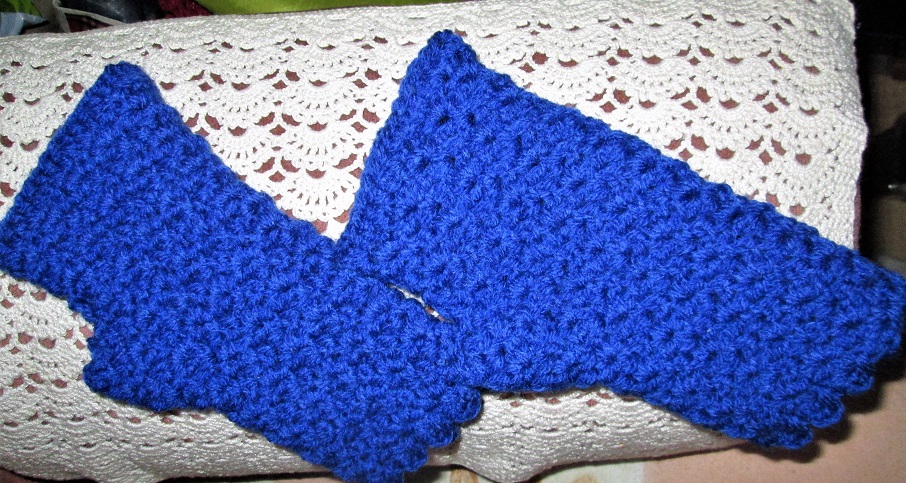
Part of my autumn/early winter ritual involves listening to seasonal music and stitching seasonal items. Here are some more things that I made over the past few months. Some went to other people and some live with us.


crocheted fingerless gloves
rose pin
same rose as the pin above, but different yarn, button and finished as an ornament

granny trees

I loved this button on this snowflake, so I kept one for myself
I needle-tatted my way from one year to the next last night, working on a larger project that I hope to actually finish at some point. In addition to a few ongoing big projects, I have some ideas I want to try out. I am going to have to get myself into some kind of routine, now that my hibernation season has ended, so that I can get some things done--stitching and otherwise.

So here we are. 2019 is upon us. I hope the year is choc-a-block with wonderful moments, good health, and inner peace!


Monday, December 31, 2018

Fading Away

As 2018 fades away, I've been taking some time to hibernate and reflect. I've thought about some things I want to do in the new year, looked back on things that happened this year, and considered what I've learned. We have learned that it's good to make plans and goals, because they help us begin on a path, but we also know that we have to be prepared to let go of the plan and take a different path as we proceed. Weird stuff happens and by holding things lightly, we allow ourselves to take advantage of opportunities when they arise. So, while I know there are some things I want to try in the coming year, I have no expectations about how they will turn out.

One thing we were thinking about involved deciding what places we want to explore this year, whether on days trips or those that are a bit longer. We made one decision--to walk The Great Western Greenway, starting in Westport and ending up in Achill. This is a 42 km, traffic-free cycling/walking path created on the route of a disused railway line along the coast of Clew Bay in Co Mayo. It falls naturally into three segments of 11km, 18 km, and 13 km, between towns and villages and that's how we'll proceed. Bill randomly picked a date to book in Westport and then went from there to see if he could get rooms for the proper nights in the villages along the way and he did. He chose a date 5 months from now, so with it being so far in advance, he had no problem with availability and got really good prices, too. I'm quite looking forward to this! The surroundings will be gorgeous and we'll have enough time, once we leave the trail for the day, to do a bit of wandering around in each village we'll stay in. The one thing that I was sad about was that I think we will miss the opening of the Old Irish Goat Centre in Mulranny by just a day or two. However, if we like a place well enough, we can always go back and spend more time there, so perhaps a longer visit to Mulranny will happen sometime. If it does, I will make sure to go when the centre is open!


So as 2018 fades into the mist, I hope you have some happy memories from the year that was and make many more of the same in the year to come.
photo by bill burke


Monday, December 24, 2018

Season's Greetings!

Whether you're celebrating Christmas or not, I hope your week is wonderful.